
Component order rule 1 – left to right
Chinese characters are made up of one or more “blocks” of self-sufficient strokes. I use the word component to refer to these blocks of strokes.
If you consider the kanji 林 hayashi ‘woods’, you can see it has two components: 木 ki ‘tree’, and another 木 ki.
If this time you consider the kanji 森 mori ‘forest’, you can see it has three components: 木 ki ‘tree’ repeated three times.
Component order rule 1 says:
Write kanji components from the left to the right.
Let’s see our first component order diagram.
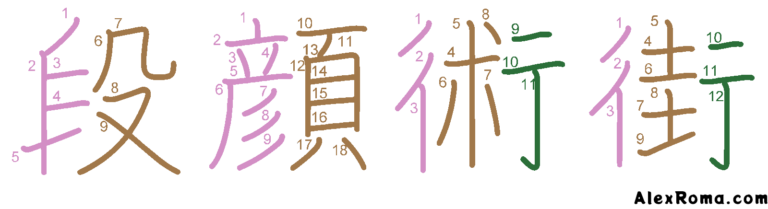
Left to right, so:
- first we write the red component;
- second we write the brown component;
- last we write the green component.
For now we can ignore the fact that a kanji like 術 JUTSU and 街 machi could be seen as the combination of 行 iku ‘to go’ with a middle component.
Now take 段 DAN and 街 machi: in both kanji the brown component can be split further into smaller components. Do you recognise them?
The smaller components are: 几 ru, 又 mata and 土 tsuchi. In what order should we write them?